The Rise of the Pre-Purchase Relationship: Why Your Brand's Best Work Happens Before Anyone Buys (or Visits)
For most of modern marketing history, brands have organised themselves around a simple assumption: people meet you when they're ready to shop. You show up in a search result, an ad, a store window. You make your case. They buy, or they don't.
That assumption is breaking down. Today, a growing share of the relationship between a brand and a customer starts long before a purchase is even on the table — through a creator's video, a pop-up experience, an online community, or a limited-time moment that has nothing to do with a transaction.
This isn't a minor shift in tactics. It changes what marketing teams need to build, measure, and connect. Here's what's driving it, what it looks like in practice, and — importantly — what happens after the moment of engagement, which is where most brands still drop the ball.
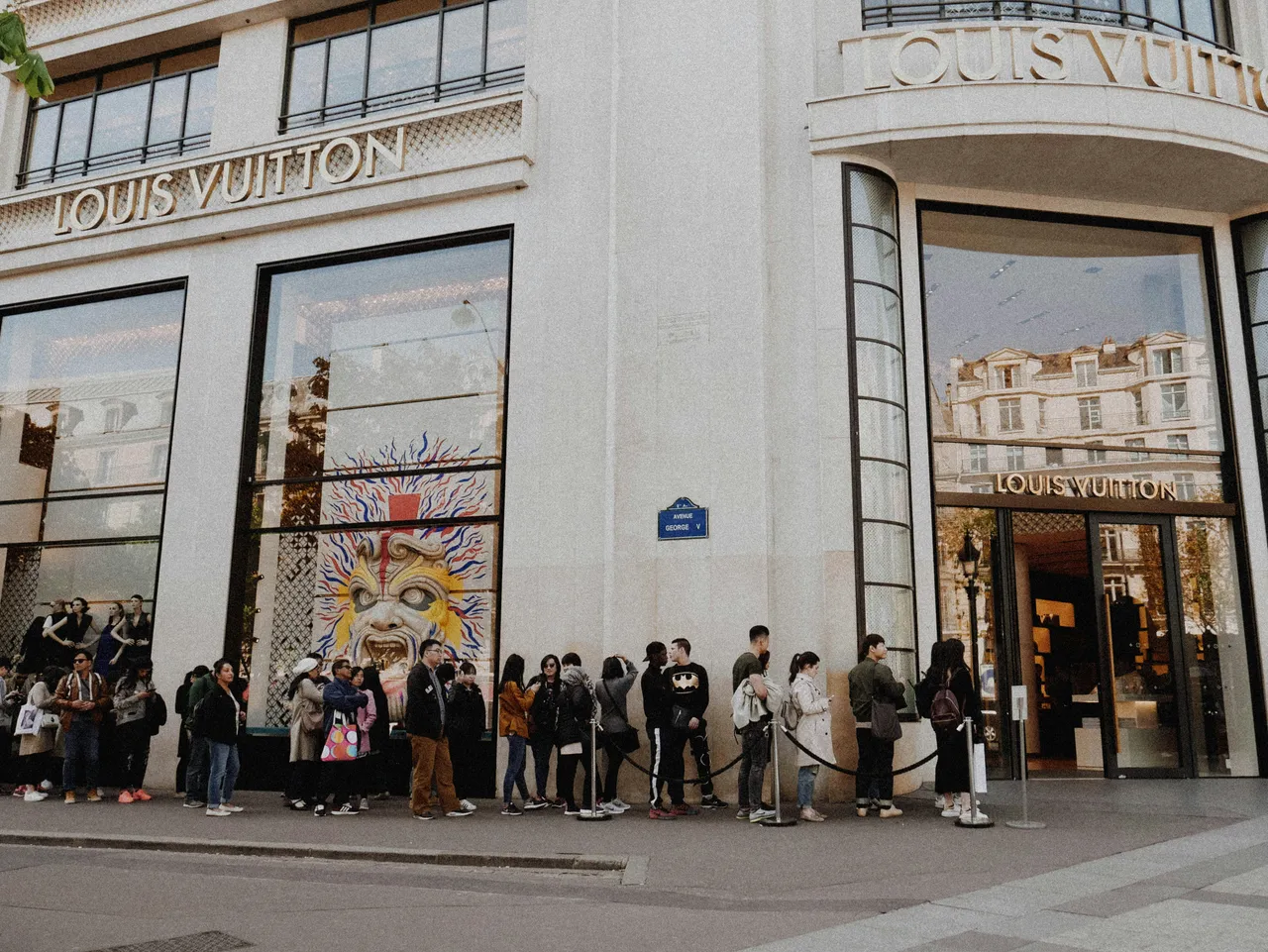
Storytelling and conversion used to be different jobs
For years, most marketing organisations split their work cleanly in two. One team told the brand story — content, culture, community, brand campaigns. Another team owned conversion — search, retargeting, email, the bottom of the funnel. They rarely shared a dashboard, let alone a strategy.
That division made sense when attention was scarce and channels were separate. It makes much less sense now, when a single post, pop-up, or product drop can do both jobs — build a memory and start a sales relationship — inside the same ten-minute interaction.
The data backs up how much this shift matters. Well-designed brand experiences consistently outperform passive advertising on the metrics that actually predict future purchases:
- Consumers spend roughly twice as long engaging with experiential activations than with traditional advertising, and 64% retain a positive impression of the brand for at least a month afterwards, according to industry research compiled by Seeker.
- 74% of Fortune 1000 marketers say they expect to keep increasing their experiential marketing budgets, per G2's 2025 research — a sign this isn't a fad, it's a reallocation of serious spend.
- Marketing research firm Eventbrite has found that younger consumers increasingly prioritise experiences over interruptive ads, a preference with real weight given how much of global purchasing power now sits with that generation.
None of this says traditional advertising is dead. It says the order of operations has changed. The relationship often starts with something worth paying attention to — not something asking for money.
What "meeting the brand early" actually looks like
This pre-purchase relationship rarely starts with a product page. It starts somewhere more human:
A creator. Someone credible shares something the brand made, and their audience trusts the recommendation more than an ad would.
A pop-up or physical experience. A brand builds a moment people want to be part of in person, independent of whether they buy anything that day.
A community. A space where people with a shared interest gather, and the brand is a member rather than a megaphone.
A limited-time drop. Scarcity and timing create urgency to pay attention, even if the urgency to buy comes later.
At that first moment, the person isn't thinking about a purchase decision at all. They're choosing to spend a few minutes — or an afternoon — with the brand, the same way they'd choose to spend time with a friend's recommendation, a good podcast, or an interesting stranger. That is a fundamentally different kind of attention than a scroll-past ad captures, and it's why the data on emotional connection is so much stronger for experience-led marketing than for interruption-led marketing.
Case study: Jellycat's diner that isn't really about the food
One of the clearest examples of this in action right now is the Jellycat Diner Experience, a collaboration between the British plush toy brand Jellycat and FAO Schwarz inside its flagship New York store at Rockefeller Center.
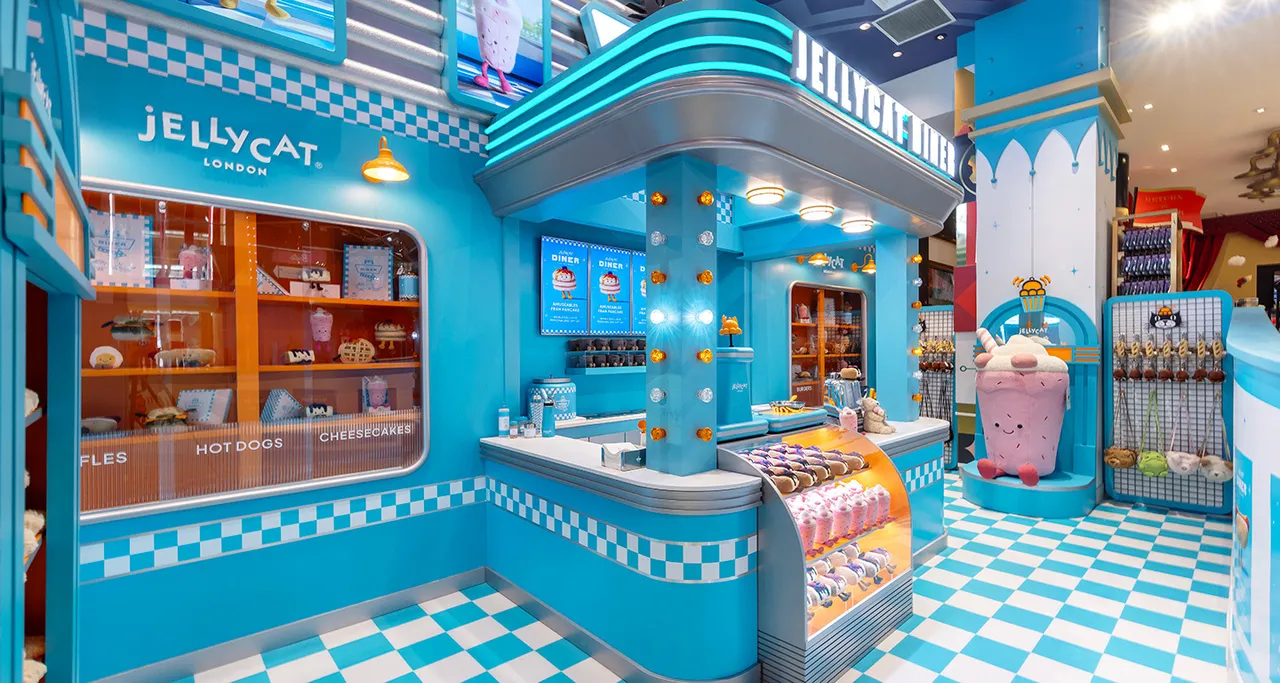
The concept: guests make a reservation (booked out roughly two months in advance, according to visitor reports), and are seated at a diner-style counter. They "order" from a playful menu of Jellycat's food-shaped plush characters — pancakes, waffles, burgers, a milkshake — while staff theatrically "cook" the order using props: flipping a plush pancake in a mini frying pan, drizzling pretend syrup, wrapping the finished plush like a real takeaway meal. Guests leave with the plush itself, plus personalised packaging, an exclusive enamel pin, a sticker sheet, and a tote bag. Several of the characters — including an Amuseables Pancake, Waffle, and a US-exclusive Bagel — are only available through this experience.
Notice what's actually happening here. The "product" — a stuffed toy — could be sold in thirty seconds at a till. Instead, Jellycat has built a ten-minute piece of theatre around it, with reservations so in demand that people report waiting one to three hours or booking two months out just for a slot. The brand relationship starts with delight, scarcity, and a story worth sharing — not a transaction. The purchase is almost incidental to the experience, even though it's the thing everyone leaves with.
The pattern has since been extended to Jellycat CAFÉ pop-ups in Shanghai and Beijing, suggesting this isn't a one-off stunt but a repeatable model: build an experience worth queuing for, and the sales follow. Jellycat has lent hard into this concept and now has a page on their website dedicated to numerous brand experiences.
Case study: LEGO Ideas and buying into a community, not just a set
A longer-running example of the same principle is LEGO Ideas, LEGO's platform where fans submit their own build concepts and vote on other people's designs. If a submission reaches 10,000 supporter votes, LEGO considers it for production, with the original creator credited and receiving a share of royalties.
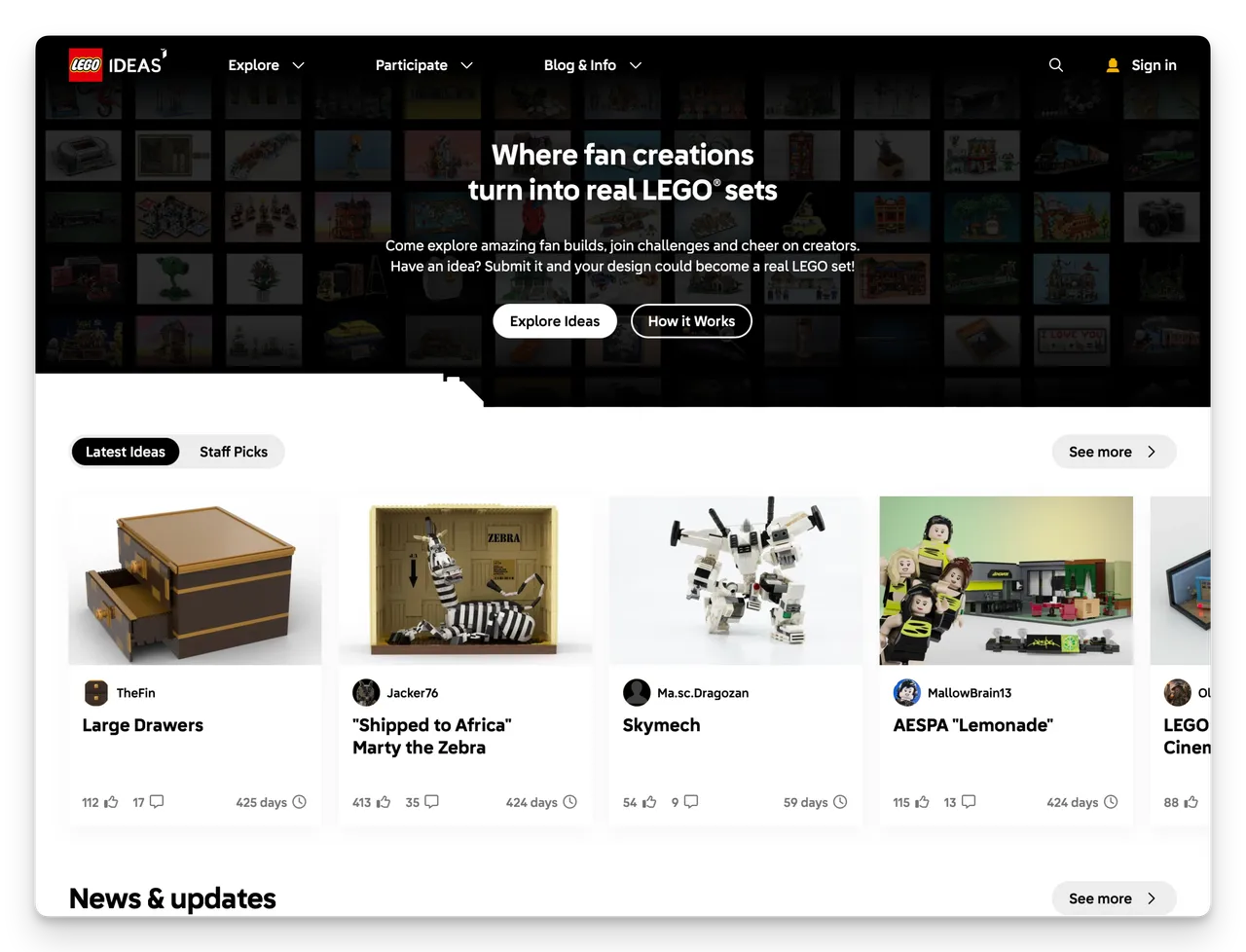
The commercial impact is notable: sets developed through LEGO Ideas have reportedly outsold comparable traditionally-designed sets by a wide margin, according to analysis from customer experience research firm Renascence.
But the more interesting part, for the purposes of this article, is what happens before any of those sets exist. People spend months designing, discussing, and voting — with zero purchase involved — because they've chosen to spend their time with the brand.
By the time a winning design goes on sale, tens of thousands of people already feel a form of ownership over it. The purchase decision was effectively made long before the product existed.
Why this works: the psychology behind it
There's a reasonably well-established body of research explaining why experience-led engagement builds stronger commercial outcomes than advertising alone:
- People form stronger, more durable memories from things they do than things they merely see. Multi-sensory, participatory formats create deeper encoding than a passive ad impression — which is a large part of why brand recall from experiential activations consistently beats recall from digital ads in industry studies.
- Emotional connection is one of the strongest known predictors of repeat purchase and loyalty. Research compiled by G2 and other industry sources has repeatedly found that a majority of consumers feel meaningfully more emotionally connected to a brand after a live or interactive engagement than after seeing an ad for it.
- Trust transfers. When an experience feels generous rather than transactional, people extend more trust to the brand's other claims — including, eventually, its sales pitch.
None of this means every brand needs a diner pop-up. It means the goal of that first interaction should be to earn attention and trust on its own terms, not to sneak in a sales pitch disguised as an experience. People can tell the difference, and it's the reason cynical "experiential" marketing — a QR code slapped on a photo booth — tends to underperform genuine ones.
The part most brands get wrong: what happens next
Here's the problem. A brilliant pop-up, a great community thread, or a viral creator moment is only half the job. Most organisations still treat these engagements as one-off events that live in a separate silo from the channels where the ongoing relationship actually happens — email, the website, loyalty programmes, retargeting.
Someone who shows up to a themed experience, engages with a specific product line, or follows a particular creator's content is telling you something real about what they care about. If the next thing they hear from the brand is a generic newsletter with no connection to what drew them in, the brand has thrown away information the customer handed over voluntarily.
This is where customer data, personalisation, and orchestration come in — and where the commercial case gets very concrete. McKinsey's long-running research into personalisation has found:
- Companies that excel at personalisation generate roughly 40% more revenue from those activities than average performers.
- Effective personalisation typically drives a 5–15% lift in revenue and can improve marketing spend efficiency by 10–30%.
- 71% of consumers now expect personalised interactions as standard, and 76% report frustration when a brand fails to deliver them.
Put those together with the experiential data above, and the opportunity is obvious: brands are getting very good at creating the spark of a pre-purchase relationship, and much less good at carrying it forward.
The follow-up email, the homepage someone lands on next, the product recommendation, the loyalty offer — all of these should build on what a customer already chose to engage with. Not as a manipulative "we're watching you" move, but as simple continuity: picking up the conversation where the customer left it.
A useful way to think about it: the experience is the opening line. Orchestration is remembering what was said, so the next conversation doesn't start from zero.
The connective tissue: consistency is what makes it feel like one brand
There's a quieter requirement sitting underneath all of this, and it's easy to overlook: none of it works if the experience, the follow-up email, the website, and the loyalty offer don't actually look and sound like the same brand.
If the diner experience feels playful and personal but the follow-up email feels corporate and generic, the connection breaks — not because the personalisation logic failed, but because the brand itself felt inconsistent. This is a well-documented problem. Research from Marq (formerly Lucidpress), based on surveys of hundreds of brand management professionals, has found that companies maintaining strong brand consistency across every touchpoint see revenue gains in the range of 10% to 33%, while roughly 81% of companies report regularly producing content that doesn't match their own brand standards.
This is the unglamorous but essential foundation for everything described above. A brand can nail the pop-up and nail the personalisation logic, and still lose the thread if the visual identity, tone, and messaging aren't reliably consistent from the first spark of interest through to the moment someone completes a purchase — and every touchpoint after that. Keeping that consistency intact, at scale, across every team and channel touching the brand, is a real operational problem, not just a creative one.
Bringing it together: a simple framework
If you're trying to apply this shift to your own marketing, a few practical questions are worth asking:
-
Where does your pre-purchase relationship actually start? Map the moments where people engage with your brand before they're anywhere near a purchase decision — creators, communities, events, content series. Most brands are surprised by how many of these already exist and how few are being tracked. e.g. Maybe someone saw a mention of a specific bike trail in your region during a mountain bike review on YouTube.
-
What does each of those moments tell you? Someone who shows up to a specific themed event, or lingers on a particular product category, has given you a genuine signal of interest. Are you capturing it anywhere useful?
-
Does your next message reflect that signal? A follow-up that ignores what someone just told you about their interests is a wasted opportunity — and increasingly, a source of frustration given how normalised personalisation has become.
-
Would a customer recognise your brand across every one of these touchpoints? If the pop-up, the email, the website, and the in-store experience don't feel like the same voice and the same visual identity, the continuity that makes personalisation feel earned — rather than creepy — falls apart.
-
Are you extending the moment, or just banking it? The goal isn't to treat every experience as a shortcut to a sale. It's to make sure the experience doesn't simply end when the customer walks away — that it lives on in the channels where the relationship continues, in a way that still feels authentic to what drew them in.
The opportunity ahead
The brands doing this well right now — a Jellycat, a LEGO — aren't succeeding because they found a clever growth hack. They're succeeding because they built something genuinely worth a stranger's time, and then had the infrastructure in place to recognise who showed up, what they cared about, and how to keep the conversation going in a voice that still sounded like them.
That last part is the part most organisations underinvest in. It's not as visible as a pop-up or as exciting as a creator partnership, but it's what determines whether a great first moment turns into a lasting customer relationship — or just a nice memory.
Further reading and sources referenced in this article:
- G2 70+ Experiential Marketing Statistics You Should Know in 2025
- Seeker 26 Experiential Marketing Statistics Every Brand Should Know in 2026
- McKinsey & Company, What Is Personalization? and The Value of Getting Personalization Right—or Wrong—Is Multiplying
- Marq (Lucidpress), State of Brand Consistency Report 2024 edition
- Renascence, How LEGO Engages Customers Through Creative Customer Experience
- FAO Schwarz / Jellycat, official Diner Experience details, and a visitor account of the New York pop-up expperience
The Rise of the Pre-Purchase Relationship: Why Your Brand's Best Work Happens Before Anyone Buys (or Visits)
The post argues that modern marketing increasingly starts before a sale, with brands building pre-purchase relationships through creators, pop-ups, communities, and limited drops. Experiential engagement creates stronger memories, emotional connections, and trust than traditional ads, but most brands struggle to carry that relationship into follow-up interactions across channels. Case studies like Jellycat’s Diner and LEGO Ideas illustrate how meaningful experiences can drive ownership and future purchases. It offers a practical framework: map pre-purchase moments, capture signals, personalise follow-ups, and maintain brand consistency across touchpoints to turn early engagement into lasting relationships.